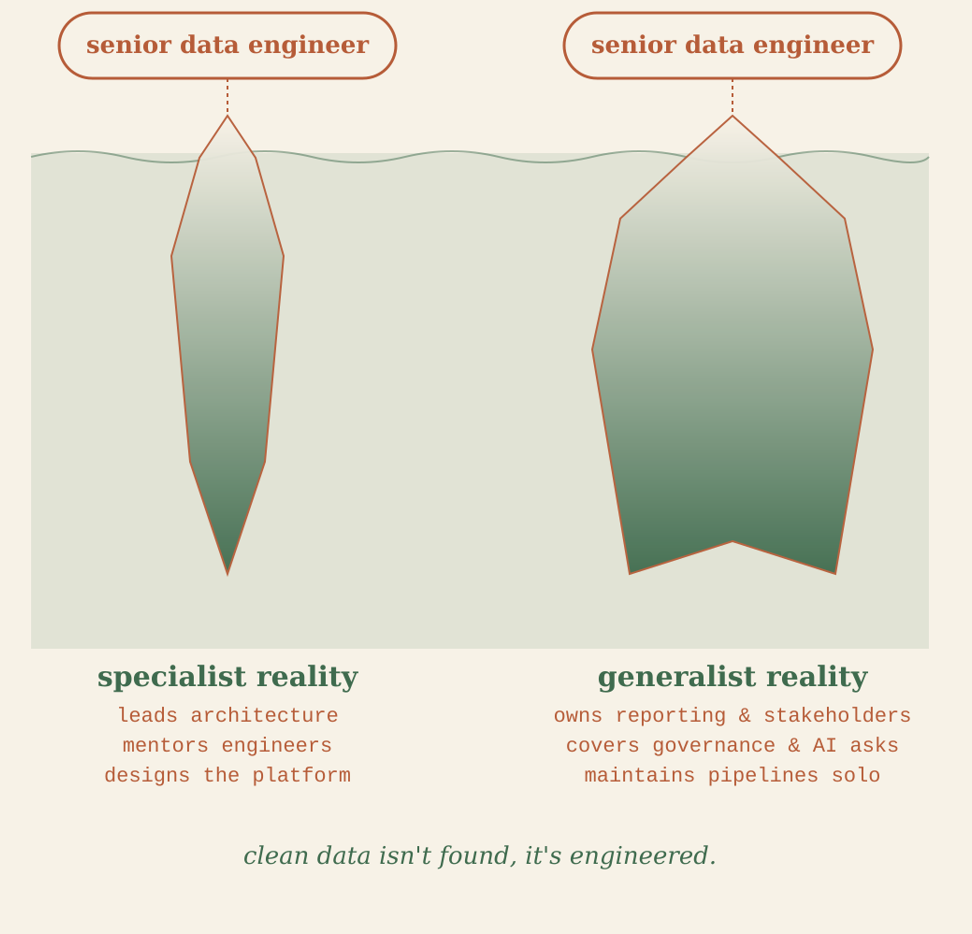
Data professionals keep getting hired into roles that are secretly four jobs. I picked that line up from a linkedin post online, and it's stuck with me ever since, it names something I lived before I had words for it. You are hired to analyse data, but soon you are also building the pipelines that bring the data in. You create the dashboards, maintain the reports, answer every “quick question” from colleagues, investigate data quality issues, document business definitions, and support the systems behind it all.
Then AI becomes a priority. Suddenly, you are also the person expected to “do AI.”
One headcount. Several disciplines. The same working week. By month six, you are overwhelmed. Requests are piling up, important work is competing with urgent work, and unfinished tasks are beginning to look like a performance issue.
The work did not get smaller. The job title simply absorbed three other roles, often for the same pay and with the same level of support as the original position.
This reflects a wider shift in the workplace. With the help of AI, generalists are becoming more capable and, in many organisations, more valuable. People can move between disciplines faster, overcome some technical barriers, and complete tasks that might previously have required specialist support.
For smaller organisations that cannot employ a specialist for every function, that can be transformative. However, there is an important difference between using AI to expand someone’s capability and using it to justify an unmanageable role.
The AI-powered generalist could be one of the most valuable professionals in a modern organisation. But without clear expectations, appropriate recognition, and realistic boundaries, the role can quickly become an organisational shortcut.
AI is lowering the barriers between disciplines
Before generative AI became widely accessible, moving beyond your main area of expertise often required considerably more time.
A data analyst who needed to write unfamiliar SQL might have searched documentation, asked a colleague, or spent hours working through errors. A business analyst creating a technical specification may have needed more support from a developer. Someone automating a repetitive process might have had to wait for specialist resources to become available.
AI has changed some of that. It can help professionals understand unfamiliar code, draft documentation, explore new tools, generate initial solutions, summarise requirements, troubleshoot errors, and learn new concepts more quickly.
A data professional can use AI to:
Draft and improve SQL queries
Understand unfamiliar scripts
Create initial data transformation logic
Develop report descriptions and technical documentation
Explore possible automation opportunities
Translate technical findings for business stakeholders
Research approaches to emerging AI use cases
This does not automatically turn a data analyst into a data engineer, AI engineer, software developer, or governance specialist. Expertise is not created by simply entering a prompt but it can help capable professionals stretch beyond the traditional boundaries of their roles. It can reduce the time required to get started, support learning, and make it easier to work across connected disciplines.
That is why generalists are becoming increasingly valuable.
They do not necessarily know everything in depth. Their strength is that they can connect different areas of work. They understand enough about data, systems, reporting, processes, governance, and business needs to see how the pieces fit together.
In smaller organisations, this ability can be particularly useful.
Why smaller organisations need generalists
Large organisations may have separate teams for data engineering, business intelligence, data analysis, architecture, governance, machine learning, application support, and automation.
Smaller organisations often do not have that structure.
Instead, they have “the data person.”
That person may be responsible for bringing data into the organisation’s analytical platform, modelling it, building reports, investigating inconsistencies, responding to requests, supporting users, and translating business questions into technical solutions.
The role may span:
Data ingestion
Data transformation
Business intelligence
Dashboard development
Ad hoc analysis
Data quality
Application support
Stakeholder management
Governance and documentation
AI exploration and delivery
From the organisation’s perspective, hiring someone who can operate across these areas makes sense. A smaller company may not have enough work or enough budget to recruit a separate specialist for every responsibility.
A strong generalist can connect technical implementation with business context. That person can identify when a reporting issue is actually a source-system problem, when a dashboard request requires a clearer business definition, or when an AI idea depends on data that is not yet reliable.
That breadth is valuable. AI increases that value by helping generalists work faster, learn more quickly, and address a wider range of challenges.
But this is also where the risk begins.
An organisation can appreciate a generalist’s ability to connect multiple areas or it can treat that versatility as unlimited capacity. Those are not the same thing.

There is nothing inherently wrong with being a generalist.
Some professionals enjoy variety. They like moving between technical work, problem-solving, stakeholder conversations, and strategic thinking. They are energised by learning new tools and understanding how different parts of an organisation interact.
The problem begins when breadth becomes job compression.
Job compression happens when several distinct roles are quietly combined into one position without the capacity, authority, compensation, or support required to perform them properly.
The data analyst becomes responsible for data engineering because someone has to build the pipelines.
The BI developer becomes responsible for data governance because someone has to define and document the metrics.
The application specialist becomes responsible for business analysis because someone has to understand the requirements and because the you work with data, leadership assumes that you should also lead AI.
None of these additions may appear unreasonable in isolation. Each new responsibility may begin as a small request or a short-term need.
Can you quickly bring this data in?
Can you build a dashboard for this?
Can you explain why these figures are different?
Can you document the business rule?
Can you look into how we could use AI here?
Over time, the temporary tasks become permanent responsibilities. Yet the organisation may continue measuring performance as though the individual still has only one job.
This creates an impossible situation.
When the professional focuses on strategic work, operational requests build up. When the professional handles urgent requests, long-term projects stall. When the professional improves the foundations, stakeholders wonder why new dashboards have not been delivered. When the professional prioritises delivery, documentation and governance are postponed.
Eventually, capacity constraints are treated as performance problems but the individual is not necessarily underperforming. The role may simply be overdesigned and under-resourced.
AI has not made the work disappear
One reason job compression is becoming easier to justify is the belief that AI enables one person to do significantly more work.
To some extent, this is true. AI can accelerate parts of the delivery process. It can help someone produce a first draft, explore an unfamiliar problem, generate initial code, identify possible errors, and organise information much faster.
However, faster task completion does not mean the responsibility surrounding that task has disappeared.
AI can help write a SQL query. Someone still needs to understand the requirement, validate the logic, test the results, assess performance, deploy the solution, and maintain it when the source data changes.
AI can help create a dashboard calculation. Someone still needs to confirm the KPI definition, reconcile the figures, handle exceptions, gain stakeholder agreement, and ensure that the calculation remains consistent across reports.
AI can help draft a data governance document. Someone still needs to speak to the right stakeholders, establish ownership, resolve conflicting definitions, obtain approval, and ensure that the documented process reflects reality.
AI can help generate an automation. Someone still needs to assess security, monitor failures, manage dependencies, and understand what happens when the process encounters an exception.
AI can reduce effort, but it does not eliminate accountability.
This is particularly important in data work because the visible output is often only a small part of the job. A dashboard may take a few hours to build, while validating the data and agreeing the definitions may take several weeks. A model may produce an output quickly, but ensuring that the output is safe, reliable, and useful requires human judgement.
The faster AI makes the visible task, the easier it can be to underestimate the invisible work around it.
Capability is not the same as capacity

This distinction needs to become part of how organisations discuss AI productivity.
Capability describes what someone is able to do.
Capacity describes how much someone can do properly within the available time and resources.
AI can expand capability. It can help a professional perform tasks outside a narrow job description and move more confidently between connected areas of work.
But it does not create unlimited capacity. A person who can build a data pipeline, create a semantic model, develop a dashboard, resolve stakeholder questions, investigate data quality issues, and explore an AI solution cannot necessarily do all of those things at the same time.
Every responsibility still requires attention. Priorities still compete. Decisions still need to be made. Systems still require maintenance. Stakeholders still need support.
When organisations confuse capability with capacity, their most versatile employees can become their most overloaded employees.
The people who are good at solving problems are given more problems.
The people who learn quickly are assigned more unfamiliar work.
The people who understand several parts of the organisation become the default owners of anything that falls between teams.
Their range becomes a reason to give them more work rather than a reason to recognise the strategic value they provide.
AI can help one person do more. It cannot help one person become an entire department.
The organisational risk of relying on one generalist
Overloading an AI-powered generalist is not only an employee wellbeing issue. It also creates significant organisational risk.
When one person is responsible for ingestion, transformation, reporting, stakeholder support, governance, and AI, that individual can become a single point of failure.
The organisation may rely on one person to know
Where the data comes from
How the pipelines work
Why particular transformations were applied
How critical KPIs are calculated
Which reports are still actively used
What known data quality issues exist
Which manual workarounds support operational processes
What stakeholders have agreed
How new AI solutions connect to existing systems
If that person is unavailable or leaves, the organisation may discover that much of its data knowledge has left too.
The apparent efficiency of one headcount can therefore hide deeper costs; undocumented processes, delayed projects, fragile systems, dependency on individual knowledge, and increasing difficulty retaining experienced staff.
There is also a quality risk.
When one professional is constantly switching between operational support, technical delivery, strategic planning, and stakeholder communication, there is less time for testing, documentation, governance, and thoughtful design.
The problem is not that the generalist lacks skill. The problem is that quality work requires focus.
A better way to build AI-powered generalist roles
The answer is not necessarily for every organisation to hire a separate specialist for every responsibility. That will not be realistic for many smaller companies.
The better approach is to design generalist roles intentionally.
First, organisations need to identify the person’s core responsibility. A broad role can include several connected activities, but it should still have a clear centre.
Is the person primarily responsible for data engineering, analytics, business intelligence, applications, or AI enablement? Without that clarity, everything data-related can become part of the role by default.
Second, responsibilities must be prioritised at an organisational level. If a new AI initiative becomes urgent, leaders should decide what existing work will be reduced, delayed, reassigned, or stopped.
Adding a priority is not the same as setting a priority.
Third, AI-supported productivity should be measured realistically. If AI reduces the time required for part of a task, that saving should not automatically be filled with more uncontrolled work. Some of the time should create space for validation, documentation, improvement, and learning.
Fourth, organisations should separate ownership from execution. The data professional may implement a business rule, but the relevant business area should own its meaning. The generalist should not become the default owner of every dataset, KPI, operational definition, and AI outcome simply because the person understands the technology.
Fifth, versatile professionals should be recognised appropriately. If someone is genuinely operating across data engineering, analytics, governance, applications, and AI, that breadth should be reflected in the person’s title, progression, decision-making authority, and compensation.
Finally, organisations need to know when specialist support is necessary. Generalists are effective because they connect disciplines, not because specialists have become unnecessary.
The best model may be a strong internal generalist supported by specialist expertise for areas involving advanced architecture, security, regulation, machine learning, or complex engineering.
The future belongs to generalists, but not unsupported ones
AI is making capable generalists more valuable.
Professionals who can connect data, technology, business processes, governance, and communication will play an important role in helping organisations adopt AI practically. This will be particularly true in smaller organisations, where broad thinking and adaptability are often essential.
But greater capability should not become an excuse for careless role design.
There is a difference between giving someone the tools to work across disciplines and expecting that person to carry several departments alone.
There is a difference between supporting professional growth and continually expanding a job description without removing anything.
And there is a difference between an AI-powered generalist and an under-resourced employee using AI to survive an impossible workload.
AI can reduce friction between roles. It can accelerate learning and help people complete some tasks more efficiently.
What it cannot do is remove the need for expertise, ownership, accountability, focus, and time. The future may belong to AI-powered generalists. But organisations must not confuse versatility with unlimited availability, or capability with capacity.
If one employee is consistently doing the work of four roles, the question is not simply whether that employee could become more productive.
The better question is whether the organisation has mistaken resourcefulness for resourcing.