A few years ago, if someone told me they were a Data Engineer, I thought I had a fairly good idea of what they did.
Today, I’m not so sure.
The more data professionals I meet, the less I believe job titles accurately describe the work people actually do.
I’ve met Data Engineers who spend most of their time building pipelines and managing cloud platforms.
I’ve met Data Engineers who spend most of their week creating dashboards, supporting users, fixing data quality issues, and answering stakeholder questions.
I’ve seen professionals with identical titles performing completely different jobs.
That’s because, in data, a title often tells you less about the work than you might think.
The same title, different realities
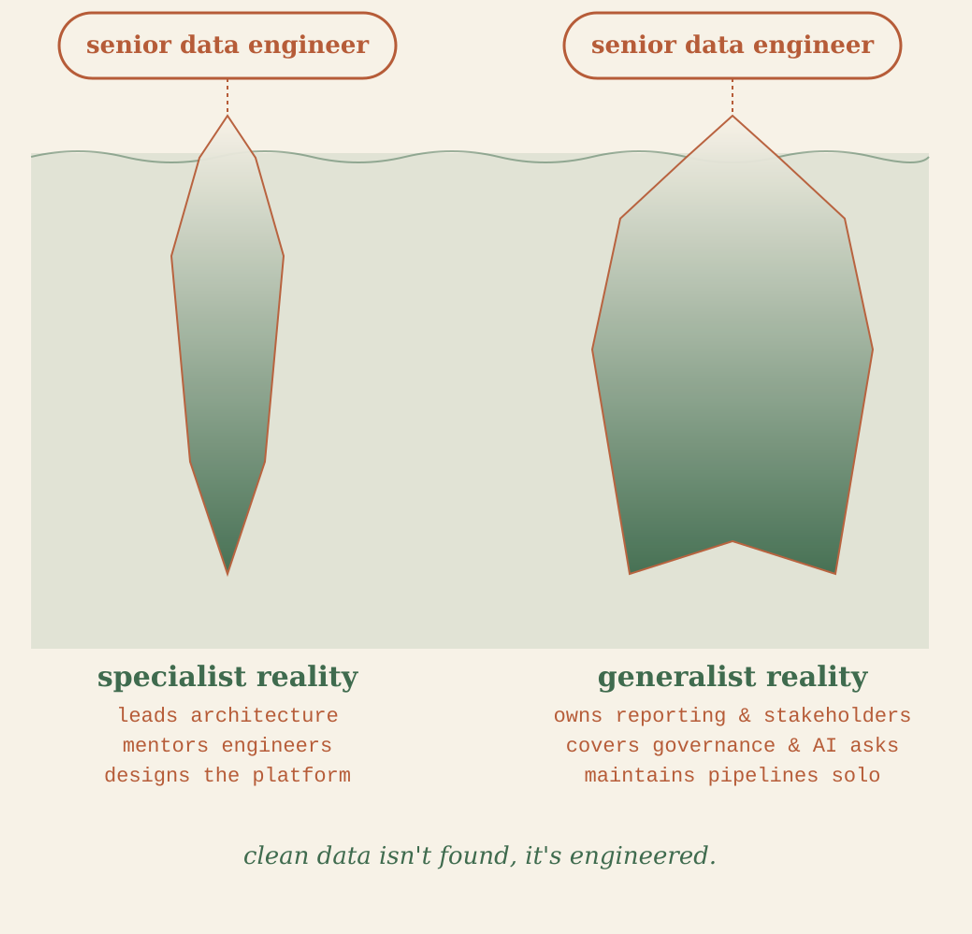
Imagine two people introducing themselves as Senior Data Engineers.
One leads architecture decisions, mentors engineers, and designs enterprise-scale data platforms.
The other is the only data professional in the organisation, juggling reporting requests, pipeline maintenance, stakeholder meetings, governance discussions, and the occasional "Can we use AI for this?" conversation.
Both have the same title, both add value, but they operate in completely different environments.
This is why comparing roles based purely on titles can be misleading. The scope, complexity, and responsibilities hidden behind the title can vary dramatically from one organisation to another.
The rise of the accidental generalist
Part of the challenge is that data roles have expanded.
Many organisations, particularly smaller ones, don't have separate teams for data engineering, business intelligence, governance, analytics, application support, and AI.
Instead, they have "the data person." One day you're building a data pipeline.
The next day you're investigating a reporting discrepancy. Then you're documenting KPI definitions, supporting users, cleaning data, attending governance meetings, and exploring an AI use case.
The title may stay the same.
The role doesn't.
Over time, many data professionals become accidental generalists, taking on responsibilities well beyond what the original job description suggested.
I've dealt with this extensively in a previous article, The AI Generalist: Opportunity or Organisational Shortcut?, where I unpacked whether this kind of role compression is a genuine opportunity or just an organisational shortcut dressed up as one.
AI is making this even more interesting
AI is making generalists more capable.
Tasks that once required significant research or specialist knowledge can now be completed faster with AI-assisted tools.
That’s a good thing.
But it also creates a new challenge.
Because someone can do more, organisations sometimes assume they should do more.
A Data Engineer who understands reporting becomes responsible for analytics.
A Data Engineer who understands business processes becomes responsible for governance.
A Data Engineer who is curious about AI becomes responsible for AI initiatives.
The title stays the same.
The expectations keep growing.
The question every candidate should ask
Whenever I’m looking at a role, there is one question I think is more valuable than reading the title;
“Can you walk me through a typical day or week in this role?”
The answer usually reveals far more than the job description.
Who owns reporting?
Who owns governance?
Who handles stakeholder requests?
Who supports the platform?
Who is responsible for AI initiatives?
Who gets called when something breaks?
Those answers tell you what the role actually is.
Sometimes you’ll discover a highly specialised position.
Sometimes you’ll discover that the organisation is effectively looking for an entire data team in one person.
The important thing is knowing which one you’re signing up for.
Focus on scope, not titles
Early in my career, I paid a lot of attention to titles. Now I pay much more attention to scope.
What problems does the role solve?
What decisions does it influence?
What responsibilities does it carry?
What business outcomes does it support?
Those questions tell me far more than any LinkedIn headline ever will.
Because in today’s data landscape, the title and the actual job are often two very different things.
What’s the biggest gap you’ve seen between a data job title and the reality of the role?