Lately, I've come across quite a number of AI-generated pictures of people in cities and countries they've probably never visited.
Someone sitting comfortably in Abuja can generate a beautiful picture of themselves standing in front of the Eiffel Tower in Paris. And the interesting part? Some of these pictures look incredibly real.
I find it fascinating how far AI has come. There's nothing inherently wrong with using technology creatively.
But something about this trend got me thinking.
If I can generate a realistic picture of myself somewhere I've never been, what stops someone else from doing the same thing with my image without my permission?
What if it's not a beautiful tourist destination but somewhere that could damage my reputation?
Or a video of me saying something I've never said?
How would I prove that it wasn't me?
This is where the conversation moves beyond beautiful AI-generated pictures to something more concerning: deepfakes and the growing difficulty of controlling our digital identities.
When Your Identity Becomes Someone Else's Content
In October 2026, Premium Times investigated AI-generated videos impersonating Nigerian public figures to promote fraudulent investment schemes.
One of the videos featured Senator Natasha Akpoti-Uduaghan, appearing to endorse an investment platform she had never approved.
The video looked and sounded like her. But it wasn't real.
According to the investigation, she had already publicly denied involvement in similar videos.
Now imagine an ordinary person facing the same situation.
A manipulated video circulates on WhatsApp, reaches family members, colleagues, and friends, and people begin drawing conclusions.
Before the person even becomes aware of it, their reputation is already being questioned.
What makes this particularly disturbing is that the person doesn't need to participate in creating the content.
Their publicly available images or recordings may be enough to make impersonation possible.
The Computer Vision Behind the Illusion
Having worked with Computer Vision, particularly pose estimation and image annotation, I find the technology behind synthetic media especially interesting.
In pose estimation, models identify key points on the human body to understand posture and movement. Image annotation involves labelling visual data to help models recognise patterns.
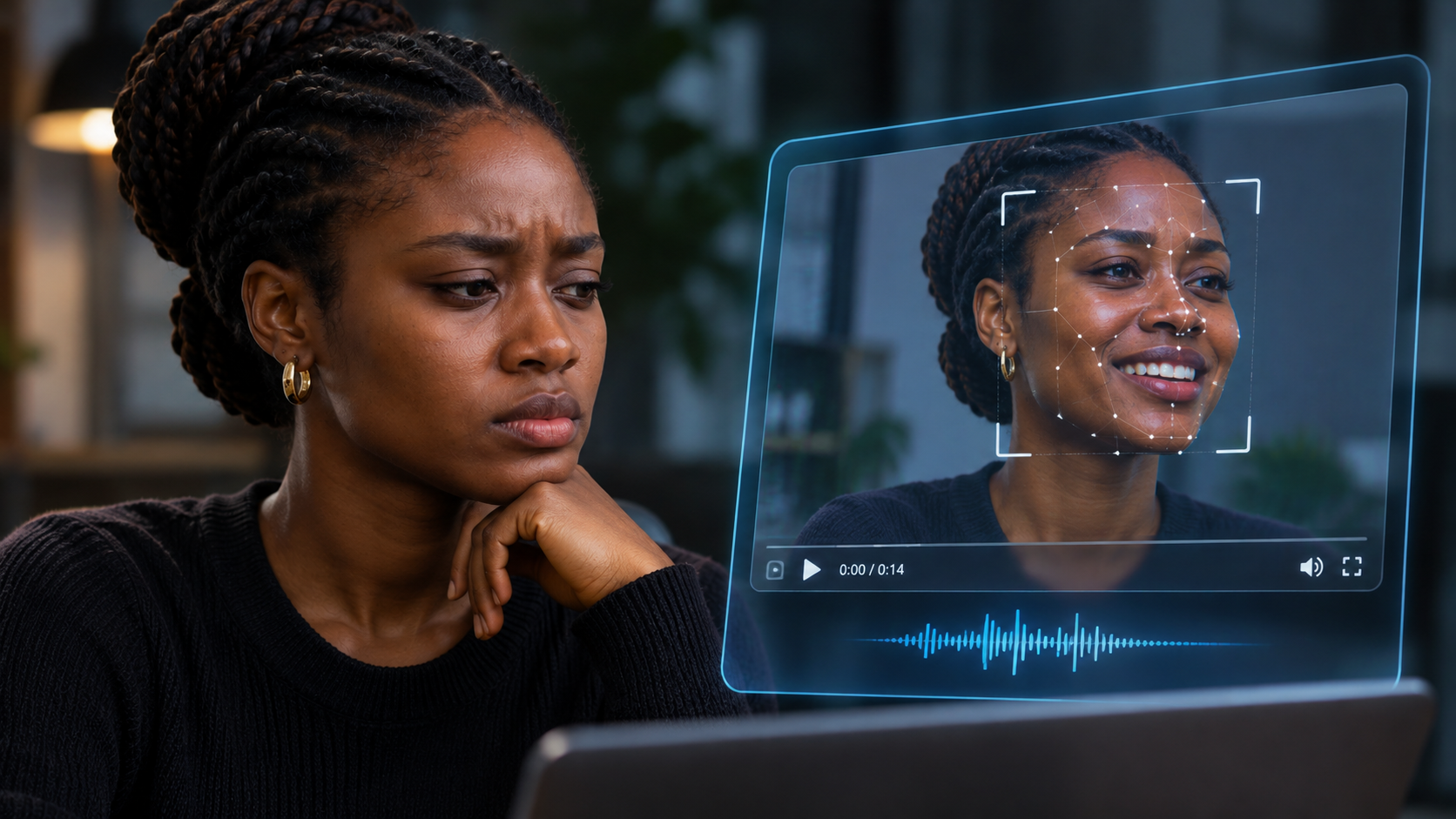
Facial landmark detection works with related principles, identifying points around the eyes, nose, mouth, and jawline.
Now, imagine combining visual information about someone's facial structure and movement with a generative model capable of synthesising realistic images.
This helps explain some of the capabilities behind facial reenactment and other forms of synthetic media.
Deepfake systems have evolved from earlier approaches involving autoencoders and Generative Adversarial Networks (GANs) to include diffusion-based models and other advanced generative techniques.
Of course, recognising a face and generating one are different tasks. Not every Computer Vision system is a generative system.
But advances across these fields have made it increasingly possible to create convincing visual representations of people and actions that never occurred.
And this raises a question beyond model performance.
Just because technology can recreate someone's appearance, does that mean anyone should be allowed to use it?
When a Fake Image Causes Real Damage
One of the most disturbing applications of deepfake technology is the creation of non-consensual intimate images.
Imagine someone taking an ordinary photograph from a person's social media profile and using AI to create a sexually explicit image.
The person never posed for it. The event never happened. Yet the image could circulate as though it were genuine.
A 2026 study published in the International Journal of Human-Computer Interaction surveyed 7,230 adults across Australia, the United Kingdom, and the United States.
It found that 7% reported experiencing AI-generated image-based sexual abuse.
This wasn't simply about fake pictures circulating online. Victims reported consequences affecting their emotional well-being, relationships, and other aspects of their lives.
And that's what makes this issue particularly serious.
An image can be fabricated, but the humiliation, broken trust, and reputational damage it causes can be very real.
For people whose relationships, employment, or standing within their communities depend heavily on reputation, the consequences can extend far beyond social media.
The most troubling part is that the person being represented may have no idea the content exists until the damage has already begun.
Can We Trust AI to Detect AI?
If AI can generate convincing fake images and videos, can't we simply train another AI system to detect them?
Yes. But there's a technical challenge that makes this more complicated than it sounds.
Generalisation.
In machine learning, a model can perform exceptionally well on familiar data but struggle when exposed to something different.
Imagine training a deepfake detector using images from five generative models.
It achieves excellent results during testing.
Then a new model is released, producing images with different characteristics.
Will the detector recognise them?
Not necessarily.
A fascinating study presented at CVPR 2025, titled Community Forensics: Using Thousands of Generators to Train Fake Image Detectors, explored this challenge.
The researchers assembled a dataset containing approximately 2.7 million images generated by 4,803 different models.
Their findings showed that increasing the diversity of generators used during training improved detection performance, including on previously unseen generators.
Think about what that tells us.
The challenge isn't simply teaching a model to recognise fake images. It's teaching it to identify manipulation techniques it hasn't encountered before.
And this is particularly important as generative AI continues to evolve.
A detector that works well today may not be equally reliable against tomorrow's generation techniques.
This doesn't mean deepfake detection is useless. Far from it.
But it means we shouldn't rely entirely on detection scores to establish whether digital content is authentic.
We also need content provenance, independent verification, and stronger mechanisms for identifying and reporting impersonation.
The Real Problem Is Losing Control
For me, the biggest concern isn't that people can generate realistic images.
It's that someone can create a version of another person without their knowledge or permission.
If I generate an AI picture of myself in Paris, that's my choice.
But if someone uses my photograph to create a misleading or humiliating image, that's no longer harmless creativity.
It's an issue of consent and control.
And while developers have a responsibility to build safeguards against misuse, platforms also need effective ways to respond when someone's identity is exploited.
As individuals, we need to become more careful about accepting visual content as unquestionable evidence.
Seeing a familiar face or hearing a familiar voice doesn't automatically prove that the person participated in what we're watching.
Before sharing sensitive or damaging content, verifying its origin may be more important than reacting to how convincing it looks.
Final Thoughts
The next time you come across an AI-generated photograph of someone standing in a country they've never visited, appreciate the creativity.
But consider what happens when the person in the image isn't the one who requested it.
We are entering an era where someone can appear in a photograph they never took, speak in a video they never recorded, or participate in an event that never happened.
And while technology may eventually help us detect more of these manipulations, detecting something as fake doesn't automatically undo the harm it has caused.
Perhaps the biggest challenge ahead isn't whether machines will become better at recognising deepfakes.
It's whether we can build a digital world where people's identities remain protected, even when their likenesses can be recreated.
Because the frightening thing about deepfakes isn't just that people might believe something you never did.
It's that you may have to prove your innocence in a reality someone else created for you.