
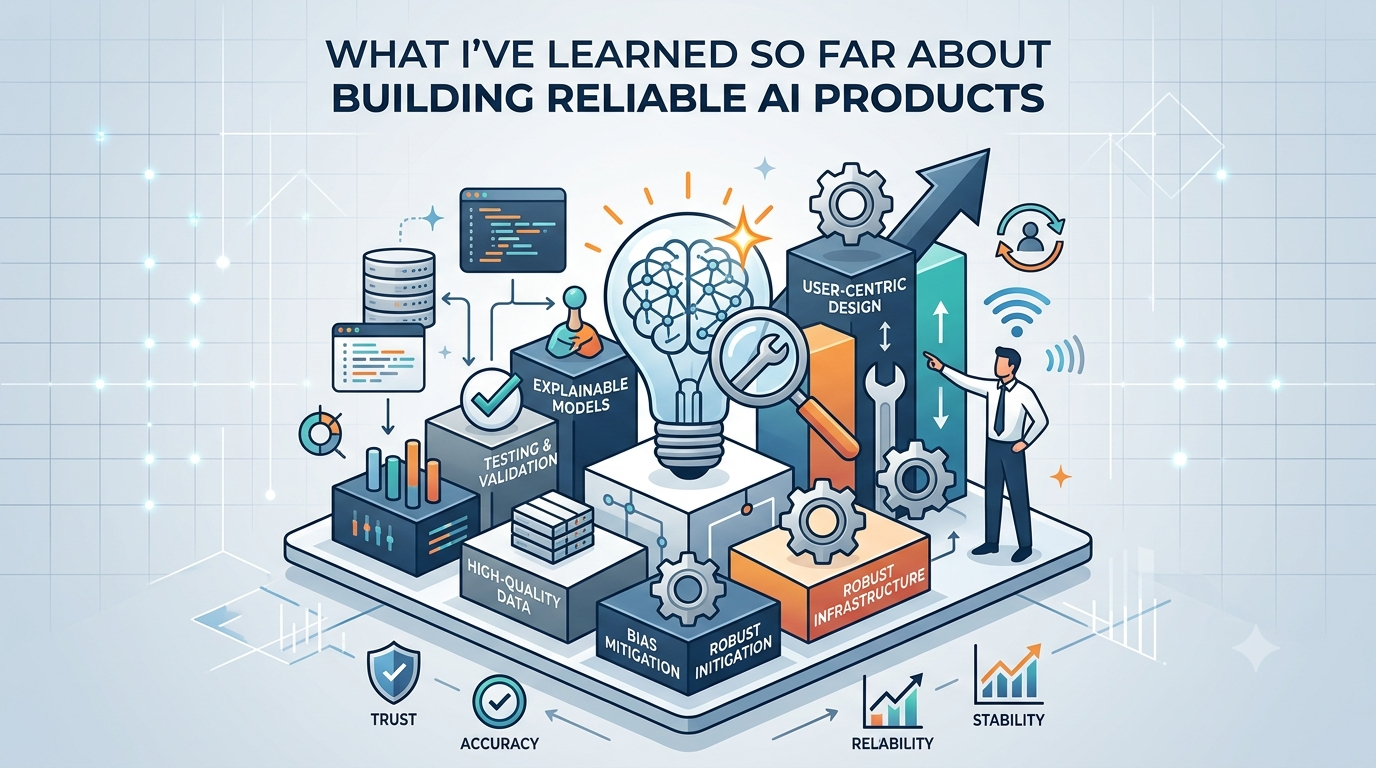
When I first started building AI products, I quickly realised that the hardest part was not choosing a model or picking a framework. The real challenge was building something that people could actually use, trust, and return to.
A lot of AI discussion focuses on what is exciting, new, or technically impressive. But in practice, the products that matter most are the ones that solve real problems well. They work consistently. They are easy to understand. They give users confidence. That has been one of the biggest lessons for me so far.
This is my first article on Empirq, so I wanted to keep it practical and honest. I am still learning, but these are some of the ideas that have already shaped how I think about building AI products in the real world.
Start with the problem, not the technology
One of the first lessons I learned is that it is very easy to begin with the technology and forget the actual problem. In AI, there is always something new to try. A new model, a new workflow, a new retrieval method, a new library. That can be exciting, but it can also pull you away from what really matters.
Before writing any code, I now try to answer a few simple questions:
What problem am I solving?
Who is this for?
What does success look like?
Why would someone trust this product?
Those questions help me stay focused. If I cannot answer them clearly, then the product is probably not clear enough yet.
A strong AI product starts with a real user need. The technology should support the problem, not distract from it. That mindset makes it easier to decide what to build, what to leave out, and how to keep the product grounded.
Keep the system simple at the beginning
Another lesson I have learned is that simplicity matters a lot, especially in the early stages. When you are excited about a product, it is tempting to add too many layers too soon. You want the system to look advanced. You want it to feel powerful. But too much complexity early on often creates more problems than it solves.
A simple system is usually easier to:
build
test
explain
debug
improve
That does not mean the product has to be basic. It just means each part of the system should have a clear purpose. If something is not helping the user, or making the system better in a meaningful way, it may be unnecessary at that stage.
I have found that simple systems often give better long term results because they are easier to understand. When something breaks, you can trace the issue faster. When you want to improve a feature, you know where to make the change. That kind of clarity is valuable.
Build for reliability, not only for impressive output
In AI, it is easy to focus on whether the output looks good. But a real product needs more than a good demo. It needs reliability. Users need to know that the product will work consistently, not just once in a while.
A system can produce a strong answer and still fail as a product if it is slow, confusing, unstable, or difficult to use. That is why I now think about the full experience, not just the model response.
For me, reliability means things like:
clear error handling
predictable behaviour
reasonable performance
stable input and output flow
graceful fallback when something fails
Even if a user never sees the technical details, they will feel the difference. A reliable product feels calm and trustworthy. It gives the impression that someone has thought carefully about how it should behave in real use.
Tiny example of thinking about reliability
Sometimes reliability starts with very small design choices. For example, if a system needs to return a result, I like to think about what should happen when the result is missing or incomplete.
result = get_ai_response(query)

if not result:
    result = "I could not find a confident answer yet."
This is a tiny example, but it reflects a bigger idea. Good products should handle uncertainty clearly instead of pretending everything is perfect. That makes the experience better for users, and it also makes the system easier to trust.
User feedback is one of the most valuable tools
Another important lesson is that real feedback is extremely useful. As builders, we often think we know what users want. But actual users notice things that are easy to miss when you are working close to the product.
Feedback helps reveal:
where users get confused
which steps feel too slow
what features are genuinely useful
what should be improved first
Sometimes the smallest comment can point to a much bigger issue. A user may say one button feels unclear, but that may reveal a deeper problem with the entire flow. That is why feedback is so valuable.
I have learned not to treat feedback as criticism. I try to treat it as information. It shows where the product can become better. The more I listen, the more practical the product becomes.
Good AI products make complexity feel simple
One thing I really respect in product design is when a system feels simple to use even though the internal logic is complex. That is one of the strongest signs of a well built AI product.
Internally, the product may involve:
model calls
retrieval steps
parsing
ranking
validation
storage
orchestration
But the user should not have to think about all that. From their point of view, the experience should feel straightforward and smooth.
That is what good product design does. It hides unnecessary complexity and lets the user focus on the task they came to complete. The more natural the experience feels, the more likely it is that the product will be used again.
What I am trying to focus on next
As I continue learning and building, there are a few things I want to keep improving in my own work:
solving real problems before chasing technical trends
keeping the system simple until complexity is truly needed
designing for reliability from the start
paying attention to user feedback early
making the experience feel easy even when the backend is not
These are not rules I follow perfectly every time, but they are the principles I keep coming back to.
Final thoughts
Writing this as my first article on Empirq feels like a good starting point for the kind of work I want to share here. I am still learning, but I believe the best AI products are built with clarity, care, and a real understanding of the problem they are meant to solve.
As I keep building and improving, I want to focus on practical lessons, useful ideas, and the small details that make a product trustworthy. I am excited to share more of that journey here, and I hope this first article gives a useful starting point for others who are also learning how to turn AI ideas into real products.




Comments
Sign in to join the discussion. New to Empirq? Create an account.